Tuesday, February 19, 2013

A Killing Wind - Uranium on the Navajo Nation.

Highly Toxic Uranium Mine in Cameron, AZ (New York Times 3/31/12)

On Sunday, I had the opportunity to go for a walk with my friend Jeff who lives on the Navajo Reservation. His home, an Airstream parked across from the Cameron Trading Post, sits near the Little Colorado River in Cameron, Arizona. So that's where we hiked: into the river drainage and then up a small canyon passing iron-colored cliffs stained here and there by chartreuse traces of uranium.

From the 1940's to the 1980's mining companies such as Union Carbide and many small, fly-by-night operations, blasted away at Navajo land, laying bare hundreds of uranium deposits and exposing thousands of workers to dangerous levels of radiation. When the cold war cooled off, those mines were abandoned by their owners. But though the mines might be closed, their radioactive legacy lives on.

Uranium deposit along Little Colorado River
So far, the Environmental Protection Agency has evaluated 683 abandoned mines on the Navajo Nation. One of them, somewhere near where Jeff and I walked, emits a radiation dose of one million counts per minute—a level scientists say is a direct pathway to malignant tumors. Yet that site, identified in 2010 by a cattle rancher, has not been cleaned up. In fact, as of last March, it was not fenced off or even marked with a warning sign (New York Times 3/31/12, Uranium Mines Dot Navaho Land, Leslie MacMillan). Instead, tell-tale signs of visitors are present: empty beer cans, liquor bottles, and dung left by the DinĂ© (Navajo's) cattle.

The EPA says the reason clean up has been so slow—only 34 structures and 12 residential yards have been selected for remediation—has to do with money. There is not enough of it. And because most of the mining companies that made this toxic mess are long gone, it is we, the taxpayers that must foot the bill. Which, of course, we should do. To see this land is to see the indifference of America, it's callous, self-serving, greed-infected side. The side that treats people like cogs in a machine, and treats machines as if it were gods. In the Navajo situation, the machine was the cold-war's military industrial complex. We needed uranium for bombs, and we, the US Government, "were willing to do anything to get it," according to LA Times Reporter Judy Pasternak in her important work Yellow Dirt.

What was left behind by this uranium-rush was a land, is a land, pock-marked by an insidious toxin. Yellow dirt has been used to make sidewalks and buildings on the Navajo nation. Homes were constructed next to mines, many of them built from slag. The wind is strong on the reservation, there are no trees to block its path, few shrubs or grasses. Meaning, that when those winds pick up, they pick up uranium dust, then deposit that dust on rivers and streams and houses and cars and toys and food and babies’ hands and feet. It lands on chapped and cracked lips which must be licked because the air is so dry.

Of course, it could be argued the Navajo's should clean up this mess. It's there land, their people, why not just let them do it? Again, money is the issue. The EPA estimates it could cost up to a billion dollars to clean these sites. With unemployment upwards of 40 percent, and median income only $20,000, where does a billion dollars come from? But there are other reasons the Navajo should not be left to clean up this cold war mess. There's the lethargy that comes from poverty and neglect, the inertia and distrust that comes from centuries of discrimination and disregard, and there is the hopelessness that comes from knowing you are surrounded by an invisible enemy.

Navajo Trading Post on Hwy 64, Arizona
The wind was blowing on Sunday as Jeff and I walk across the Navajo land, and we reassured ourselves it was blowing away from us. We were upwind. But of course the wind at our backs did come from somewhere.

-Naseem Rakha 2/19/13


Sunday, February 17, 2013

One Happy Elephant


Did you watch that Elephant? It is the happiest animal on planet Earth, except for me - yesterday - hiking into the Grand Canyon with Ranger Kristi Rugg, or as I think of her - Wiki - as in Wikipedia. Her knowledge of the canyon is encyclopedic. And so, as we descended the Hermit Trail I listened and learned and asked a zillion questions.

Kristi Rugg
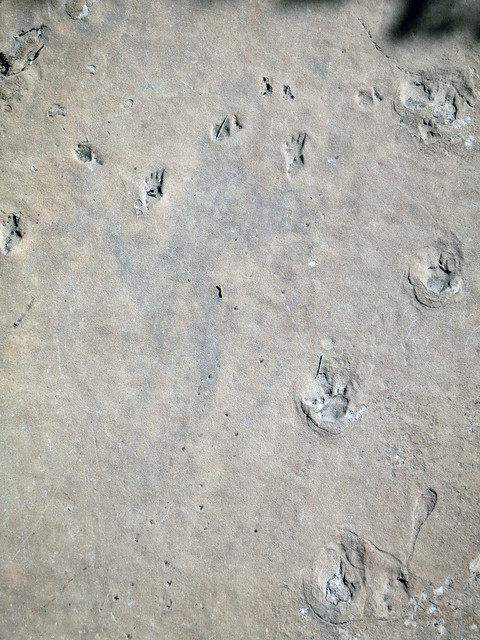
She showed me 275 million year old lizard tracks in the Coconino sandstone, pointed out Douglas Firs tucked away in shady micro-climates, and told me where I can find crinoid stems and brachiopods in the Kaibab. We talked about miners and mules and plants and paths and lightning strikes (Grand Canyon tourists come in third for lightning related deaths after golfers in Florida and those tall Texans with their ten gallon hats.) Then we talked about hypothermia and wilderness rescue and people who actually run Rim to Rim to Rim. South, North, South or visa versa, IN ONE DAY! We decided they are nuts. And we talked about The Grand Staircase Escalante Monument in Utah, which she insists I have to visit, and how we love hiking where we can see the roots of the earth. Wood walking - in Oregon - is nice, but I tend to feel I am in a green tube. But a desert hike, with its views, the sky, the chalky earth right there to be touched and seen? That's what I'm talking about.

I'm a desert girl. Born in Chicago, my home is in western Oregon - but my heart of hearts is where sky meets earth.

So yesterday I was doing the little elephant happy dance all the way down the trail. Well, not really. That would have been crazy-stupid. I was a good girl and hiked with both hiking polls, stayed true to the path, and was extra careful on the ice. But inside? I was doing the jitterbug.

This is where I belong.

After the hike, I spoke at the Shrine of the Ages. I chose a few of these Grand Canyon blogs and had my photos on a huge screen, and it was fun to not talk about The Crying Tree or the death penalty or forgiveness. And once again, I felt like a very happy elephant.

During the Q & A I was asked what I hoped to bring home from this experience and this was my answer. To remember that ultimately stuff just doesn't matter. The missed deadline, the flat tire, the illness, the broken phone, the crappy neighborhood, it just doesn't matter. Not only is life short, it is, in the scheme of things, basically insignificant. In a billion years of strata, what is human existence? A finger's thickness? Of course, I know some people disagree and think the Canyon was created about 6000 years ago by the forces of the great biblical flood. I visited a couple web sites describing this event, but I didn't hang out long. I have never been a big fan of fantasy fiction.

Hiking the Hermit Trail

The bottom line for me is that that elephant has it right. Go dance in the waves. Go hike, go watch the stars or climb a tree or ski around a mountain and get lost but come out alive knowing that is who you are. We all need to be happy elephants - at least once in a while. Time is ticking away real, real fast.

-Naseem Rakha 2/17/13

Saturday, February 16, 2013

What to Read?

Tonight at 7 PM, I am giving a presentation at the Shine of the Ages at the Grand Canyon. The presentation will last about 45 minutes. I want to talk about my relationship with the canyon, my river trips and what is has been like to be an Artist in Residence. I plan to read a few pages of my new book, and then several essays from this blog.

This is where you come in.

Please tell me what two or three essays you think I should read tonight. Which ones made you feel something or learn something or want to do something? You can post your comment below the essay.

Your opinion matters, so thanks in advance.

-Naseem Rakha 2/16/13

Friday, February 15, 2013

In Search of Silence

If silence is an island then this morning at sunrise my island was invaded by two car loads of tourists.

Looking west at Pima Point
I had driven out to Pima Point, about seven miles west of Grand Canyon Village. The place was empty. The entire road there—empty. Heaven, I thought.

The sun was just a rose glow to the east as I left my car and put on my gloves and walked to the cliff edge. Pima Point offers one of the best views of the Colorado River from the South Rim. From there I could see and hear Granite rapids, a class 8 rollar-coaster which I had rafted just five months earlier.

It was was a beautiful morning. Cold, cloudless, not a voice to be heard. Not a car, not a plane. So I sat on a rock, my legs tucked beneath me and watched the sky turn that pale peach color I associate with babies' palms. Soft. Wondrous. And within a little while the sun crested the eastern ridge, and hit the canyon walls, igniting them into colors I associate with the the Colorado Plateau: Kaibob Limestone, Coconino Sandstone, Hermit Shale. Twenty distinct layers of different aged stone dropping lower and lower until until they reach the canyon's roots: 1.8 billion year old schists and granites named after Vishnu and Zoroaster.

And just as I was thinking how grateful I was to have this quiet place all to myself, up come two cars filled with tourists. And I thought, well, whoever it is that is now opening their doors and slamming them shut, whoever it is that is parenting those screaming kids, whatever person has just hit their key-fob so that the car's horn just beeped, and now beeps again and then again, that those people, once they see this site and see me posed like Siddhartha, that they will understand. This is a time for silence. For veneration. For grace.

I was wrong.

They ran, skipped, jumped down the path, laughing, talking so loud you'd think it was mid-day at a football game. Not one single second of quiet ensued. The group shouted about this, and shouted about that, and then for a good three minutes - they shouted and shouted and shouted into the canyon, trying their best to launch an echo off those ancient walls.

Had we spoke the same language, I might have told them that if they were quiet they could hear the river. I imagined miming my message. A finger in front of my lips, a hand cupped to my ear, and then pointing to the white water below. But I felt so frustrated with them, so disappointed and annoyed that what I really wanted to do was just yell right back at them. Shut the hell up!

Silence. What a treasure. And how easy it is to quash. It happens so regularly, trumping silence for the noice of our cars, our music our voices.

There is a wonderful interview on the web entitled How Silence Works, Emailed Conversations with Four Trappist Monks. Trappists follow a "vow of silence," speaking very rarely, and briefly when they do. When asked what silence adds to their lives, one monk said.

 "...in the silence of adoration, we can arrive at a deep communion..."

Looking North at Pima Point

Reading this I understood why I was so frustrated with this morning's interlopers. Had they approached the canyon like a temple, rather than an amusement park, had they realized they were in the presence of a shrine older and grander than anything built by man, had they given the canyon the "silence of adoration," then we might have arrived at "a deep communion." One that would not have needed a common language, but instead feathered itself in the down of our reverence.


-Naseem Rakha 2/15/13

Wednesday, February 13, 2013

That's How Big the Grand Canyon Is


This is what I have to say. 

The Ponderosa Pines that sit on the North Rim of the Canyon about ten miles away from where I am on the South Rim—they look like stubble on man's chin.

That's how big the Grand Canyon is.

And the El Tovar Lodge, built in 1905, three stories, turreted top—if you walk less than a mile from here to where you can look back at the buildings, the lodge and everything else built on the South Rim look like they would cramp and ant.

That's how big the Grand Canyon is.

And if you ever get up in outer space, look down at Earth. I guess it's considered down, I'm not really sure what's considered up or down in space. But, if you get there look out the window and check out Earth. You'll eventually see the canyon. Apparently you can also see state boundaries (see satellite image above) which, when you think about it, is a little mind-blowing. I mean, what are the odds?) Anyway—

That's how big the Grand Canyon is.

In river length the Grand Canyon is 277 miles long. I've rafted them. Each one of those miles are surrounded by big tall walls of ancient sedimentary, metamorphic and igneous rock. So tall are these walls that when you look up at them you think 'god, that's a tall wall.' And yet, you are rarely looking at the top of the canyon. Probably not even close to it. The Rim World is usually obscured by these lesser cliffs, miles and miles of them going back and back and back.

That's how big the Grand Canyon is.

One million, two hundred eighteen thousand, three hundred seventy-six acres.

One thousand, nine hundred four square miles.

At its deepest, the canyon dips 6000 feet into the Earth's crust.

At its widest, eighteen miles.

If you want to drive its perimeter and don't want to hike. Plan on a two day trip. It's about an 800 mile haul. Walking its entire perimeter is the equivalent of walking from Los Angeles to New York City. Two thousand five hundred and fifty-seven miles.

That's how big the Grand Canyon is.

If you wanted, you could put either Delaware or Rhode Island inside the Grand Canyon.

If you flattened it, it would cover a good part of the American West.

If you baked something a hundredth its size, covered it with icing and tried to eat it—you would die.

That's how big the Grand Canyon is.

It's a tear in the ground. A rip. A hole. And it is huge. Absolutely humungous.

And that is what I have to say.


-Naseem Rakha 2/13/13


Tuesday, February 12, 2013

How People Die

Before bed each night I have been cuddling up with a book called Over the Edge: Death in the Grand Canyon by Michael P. Ghiglieri and Thomas M. Myers. What I have learned is that the majority of deaths in the Grand Canyon occur because of a single thing. People taking one wrong step. Or maybe a few. A few wrong steps that lead to one big wrong step. There are more deaths in the Grand Canyon than any of the other 398 parks, monuments, battle fields, sea shores, mountain ranges and deserts in the U.S. National Park System. Eighty four million acres of land, with the Grand Canyon taking the prize for most deadly.

This morning I saw a young couple watching the sun rise from the edge of a cliff. The girl was giddy with enthusiasm  Clapping her hands together, skipping around to stay warm. I held my breath as I walked by. When I returned an hour later they were gone, but I was happy to see their tracks went both ways - to the edge and then back. That later part is important. Still, every year some people only make it one way. They are here on this planet alive, laughing, talking, thinking of the beauty, the wonder and then, oh, if I just get a little closer to the edge, won't that be just the greatest view in the world—


And then they are gone.

Poof.

Just like that.

It's important to remember that the canyon is so big, so vast, so absolutely unbelievably immense that perspective is easily lost. It's hard to imagine, but good to try, that you could start at the bottom of the canyon and stack three Empire State Buildings on top of each other and they would still not be as high as the rim of the Grand Canyon. Many people fall simply because they lose their bearings. They are sitting on a ledge resting from their hike, and then they get up, get disoriented, get dizzy and fall.

Most of the deaths happen to men of a certain age. Several have been attributed to these same aged men urinating off the ledge, or walking around in the dark—drunk.

The book makes for an interesting read, and a good reminder of how indifferent this canyon is. 1.8 billion years compressed into a vertical mile of rock. What's a human life compare to that?

And for a bit more perspective, I just found this photo by Adam Shallau.


-Naseem Rakha 2/12/13

Monday, February 11, 2013

Wild Dreams

Lynx

Last night I dreamt I pet a lynx. It walked up to me and sat down then lowered its head and let me stroke the tufts of fur that stood from the tips of its ears like small black feathers. After a moment it stretched and sniffed my face, rubbed its body along my arm. I remember my son was in the dream and that he was worried for me.

I have never been very good at dream interpretation, but I know the dream left me feeling very solid—very full and happy. Something wild approached me, invited me to touch, to trust.

There are no lynx in the Grand Canyon. They are mostly a northern species, found in the boreal forests of Canada and Eurasia. Those in the lower forty-eight have largely been reintroduced. Their predecessors killed off for their incredibly thick fur. I have heard there have been lynx sightings in Oregon, but those are rare. There are bob cats in the Grand Canyon though, and cougars. A day or two after I got here I heard someone had seen a cougar within a mile of the lodge. And while rafting the canyon, I've seen desert big horn sheep, ring tailed cats (which are really in the raccoon family,) river otter and coyotes.

Yesterday, while hiking I was able to follow quite a few animal tracks through the snow: elk, deer, fox, rabbit, squirrel, chipmunk. But no cat. That would have been something, to find a fresh cat track.

The special thing about being in the canyon in winter is that there are so few people. Just a half mile away from the village I felt I had the canyon to myself. Just me and the prints of animals. I hiked a long time, returning very wet and very cold. For the first time since being here I went to sleep early. And then I dreamt of lynx.

Anyway, when I opened my email this morning I found that Chuck had sent me the following video. It takes place in Uganda and is about a man's encounter with wild Gorillas. Not Lynx. Still, it captures the essence of my dream—how special it is to touch the wild.


-Naseem Rakha 2/11/13